
What is a “Mezzala”? Have you ever wondered why Kevin De Bruyne always finds himself in the most dangerous positions, creating goal after goal for Manchester City? Is it luck, instinct, or a tactical role deeply rooted in football’s history?
Modern football is full of complex terms—false nine, regista, inverted full-back—but the mezzala remains one of the most intriguing. For some, it sounds like just another midfielder, but the truth is more nuanced. The mezzala blends creativity, mobility, and intelligence, making it one of the most vital tactical roles today.
In this article, we’ll uncover the true meaning of mezzala, explore its origins in Italian football, compare it with other midfield positions, and dive into how Kevin De Bruyne has become the perfect modern-day example. By the end, you’ll not only know what a mezzala is but also why it continues to shape Manchester City tactics and global football strategies.
The Origins of the Mezzala Role
A Legacy Born in Italy
The mezzala first appeared in early Italian formations like the Metodo and WM system. Literally meaning “half-winger,” it described midfielders who operated between central and wide areas. Unlike deep-lying midfielders, they had license to roam forward and attack.
From Tradition to Modern Football Roles Explained
As tactics evolved, so did the mezzala. In the 20th century, they played closer to the forwards, often as second strikers. Today, they function as hybrid midfielders who combine creativity with pressing power—bridging the gap between classic playmakers and box-to-box runners.
Defining the Mezzala in Modern Terms
Key Characteristics
A mezzala is not defined by rigid positioning but by his freedom. He:
Exploits half-spaces instead of staying central.
Contributes both goals and assists.
Supports wide players with overlapping runs.
Presses high to recover possession quickly.
The Attacking Number 8
Often, the mezzala is referred to as an attacking number 8, someone who plays further forward than a traditional central midfielder but not quite as advanced as a trequartista.
The Half-Winger Explained
The nickname half-winger comes from his ability to drift into wide channels without abandoning central duties. This duality makes the mezzala unpredictable.
Tactical Responsibilities of a Mezzala
Link Between Midfield and Attack
The mezzala thrives in positional play, occupying zones between the opposition’s midfield and defense.
Creativity and Chance Creation
They are often the second-highest contributors in goals and assists after strikers. Their vision and passing unlock defenses.
Defensive Work
Despite their attacking reputation, mezzalas are also crucial in pressing systems. Their positioning allows them to close passing lanes and win possession quickly.
Kevin De Bruyne: The Perfect Modern Mezzala
Manchester City Tactics Under Guardiola
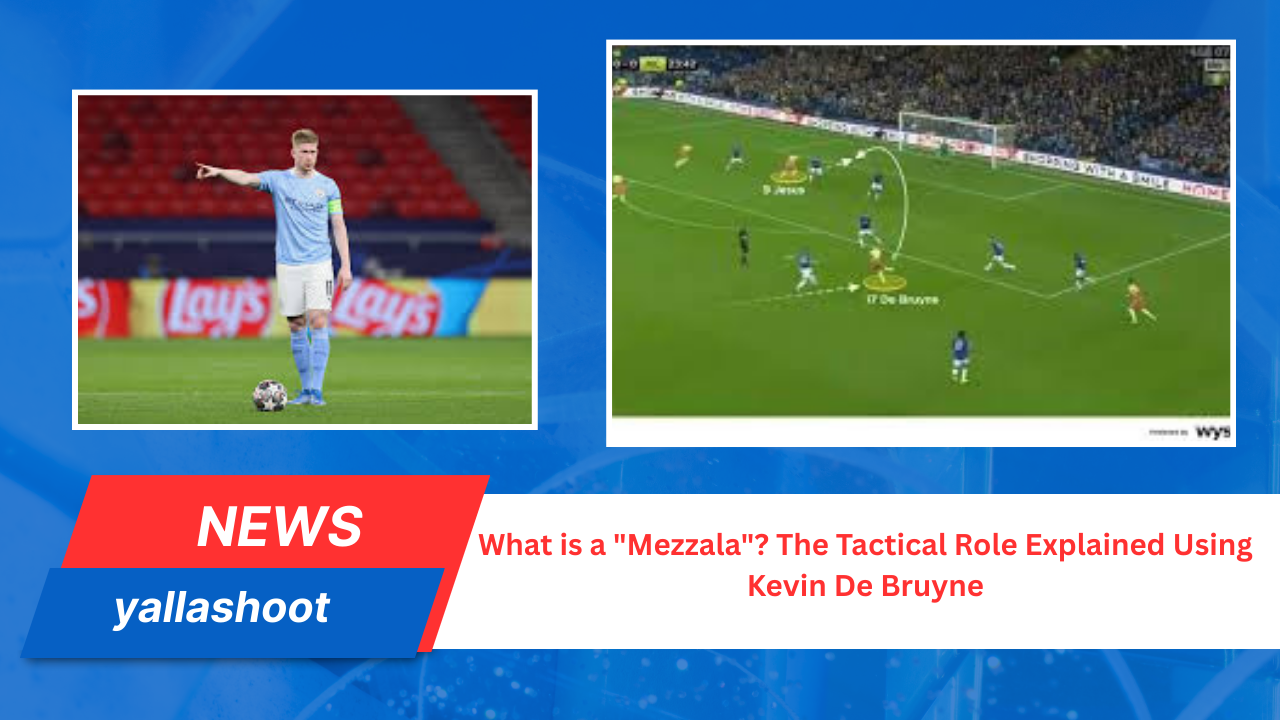
De Bruyne plays as the right-sided mezzala in Guardiola’s 4-3-3. His positioning in the half-space makes him unmarkable.
Heatmaps and Movements
Data shows that De Bruyne rarely stays wide or central—he thrives in the channel between. This allows him to receive the ball facing goal and dictate play.
Case Study: Champions League Performances
Against Real Madrid, PSG, and other European giants, his mezzala role has been decisive—whether scoring, assisting, or pressing.
Mezzala vs Other Midfield Roles
| Role | Main Traits | Positioning | Example |
|---|---|---|---|
| Mezzala | Creative, half-space runner | Between midfield and wing | Kevin De Bruyne |
| Regista | Controls tempo, deep playmaker | In front of defense | Andrea Pirlo |
| Box-to-Box | Energy, covers whole pitch | Vertical runs | Steven Gerrard |
| Trequartista | Final pass & creativity | Behind striker | Francesco Totti |
Why Modern Football Still Needs the Mezzala
Adds unpredictability to possession play.
Breaks defensive lines with clever movement.
Creates overloads on the flanks.
Combines pressing with creativity.
Famous Mezzalas in History
Gianni Rivera – Italian maestro.
Andrés Iniesta – Barcelona’s genius in half-spaces.
Paul Pogba – Modern mezzala at Juventus.
Kevin De Bruyne – Today’s benchmark.
The Future of the Mezzala
Football continues to evolve, but the mezzala remains timeless. With hybrid tactics and flexible formations, the mezzala may become even more central—blending the roles of creator, presser, and finisher.

FAQs
Q1: What is a mezzala in simple terms?
It’s a midfielder who plays in half-spaces, linking midfield and attack.
Q2: Why is Kevin De Bruyne called a mezzala?
Because he drifts into half-spaces, creates chances, and contributes defensively.
Q3: Is a mezzala the same as an attacking number 8?
Almost, but mezzalas focus more on half-spaces while number 8s cover box-to-box.
Q4: What formations use mezzalas?
Primarily 4-3-3 and 3-5-2 systems.
Q5: Do modern teams still rely on mezzalas?
Yes, especially possession-based teams like Manchester City.
Conclusion: De Bruyne as the Mezzala Blueprint
Kevin De Bruyne isn’t just a midfielder—he’s the model mezzala. His role at Manchester City shows why this position continues to define modern football. It’s about creativity, pressing, and half-space mastery.